Language: English
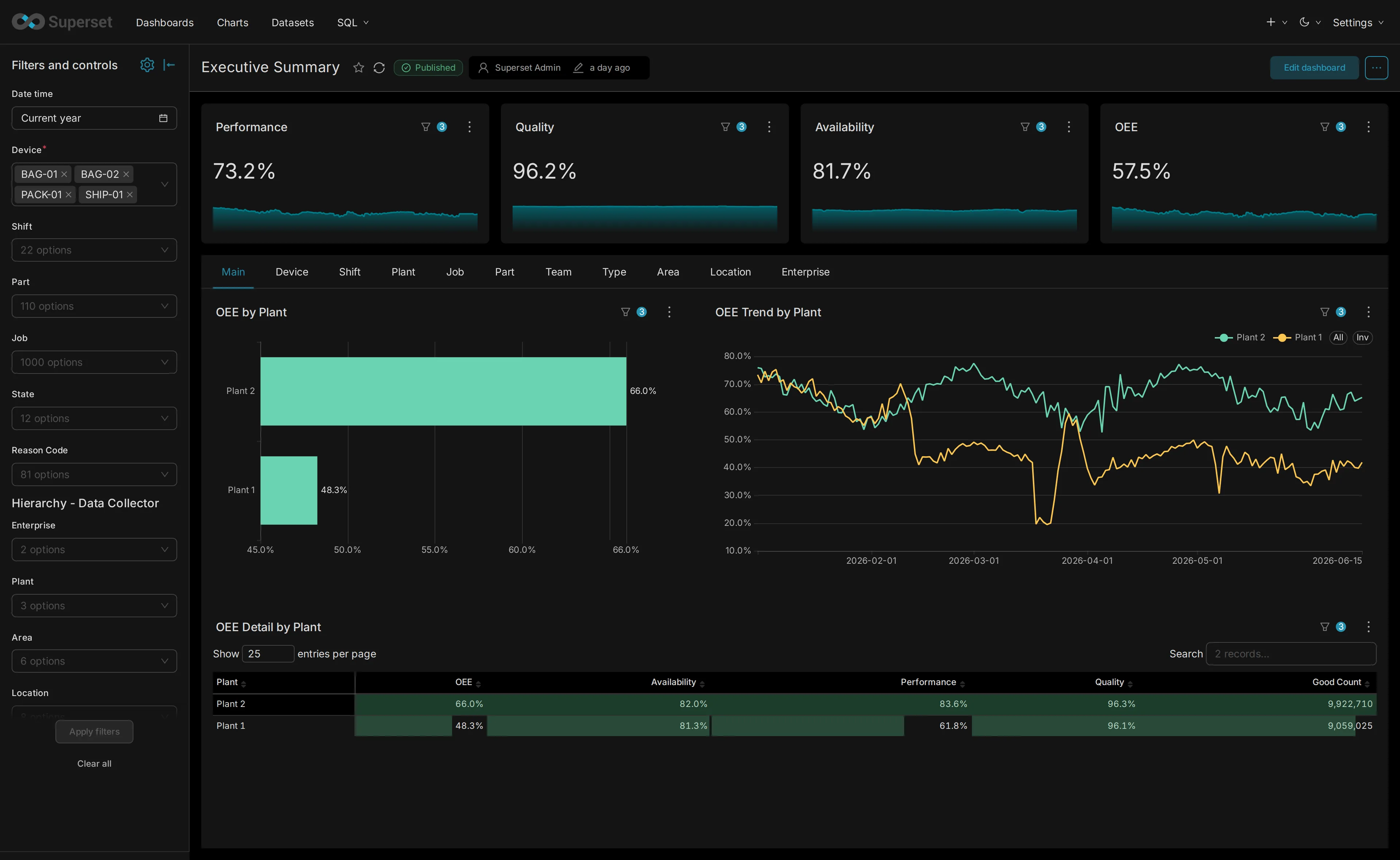
OEE Explorer executive dashboard with plant performance charts

Technical specifications

OEE IntelliSuite deployment profile.

Manufacturing software for plant-floor data capture, reporting, alerting, workforce context, and multi-system integration. The requirements below describe the server that runs it, whether that server sits in your plant or is hosted for you.

Deployment

Baseline requirements.

IntelliSuite can start with one factory and scale to global deployment. The same product stack can run on customer-owned plant infrastructure, staging environments, and centrally managed multi-site rollouts.

Host OS

Linux preferred, Windows Server supported

Debian is preferred for Linux installs. Windows Server 2022 is supported when required by plant IT.
Install mode

Containers preferred, native Windows available

Docker keeps deployments consistent. Native Windows installation is supported for sites that cannot run containers.

Minimum server

4 cores, 16 GB RAM, 256 GB disk

A starting point for a production Windows Server deployment; Linux installs can start smaller, and SSD is recommended over HDD at every tier. Minimum and recommended sizing for both operating systems is below, and final sizing depends on device count and retention.

Remote access

VPN with SSH or RDP

Support access can also use an approved outbound tunnel pattern when direct inbound access is not available.

Server sizing

Minimum and recommended.

These are server-side sizing guidelines for OEE IntelliSuite. Final sizing depends on how many years of data need to stay online, how many Vorne boards are connected, how many IntelliSuite products are in use, backup policy, and whether the deployment is Windows Server or Linux.

Windows Server

For standard Windows Server installs dedicated to OEE IntelliSuite.

Minimum

CPU
4 cores
Memory
16 GB RAM
Storage
256 GB HDD

Recommended

CPU
4 cores
Memory
32 GB RAM
Storage
256 GB SSD

Linux Server

For dedicated Linux Server installs running OEE IntelliSuite.

Minimum

CPU
2 cores
Memory
8 GB RAM
Storage
128 GB HDD

Recommended

CPU
4 cores
Memory
16 GB RAM
Storage
256 GB SSD

How to choose the tier

  • Use the minimum specification for smaller installs, pilots, or sites keeping only a few years of history.
  • Choose the recommended specification for normal production deployments, especially when keeping 5+ years of data.
  • Add storage as the number of Vorne boards grows, when backups are retained on the same server, or when reporting history needs to stay online.
  • Use SSD storage whenever possible for smoother dashboards, reports, updates, and backups.

What affects sizing

These specifications are for the server, not tablets, operator stations, or browser-only clients. A small plant using one product and a short reporting window can stay near the minimum. A larger plant with more boards, more products, and more history should plan around the recommended tier.

  • How many years of production history you want available for reporting
  • How many Vorne boards are sending data into OEE IntelliSuite
  • How many OEE IntelliSuite products you use, such as Pulse, Explorer, Work Tracker, Forms, Costing, and Continuous Improvement
  • How often your team uses reports, dashboards, and shared views at the same time
  • How long you keep backups and whether older data needs to stay immediately searchable
Confirm deployment sizing

Server access

What the host needs to reach.

The IntelliSuite server usually sits on the plant network. It needs access to the production data sources, business systems being integrated, users, and displays that will open the web apps.

Plant network

  • reachability to Vorne XL devices and other shop-floor data sources
  • network path to the XL Bolt-On Data Collector host and the SQL Server database it writes to
  • static IP or reserved address for the IntelliSuite host
  • DNS name or hostname for operator and admin access

User access

  • HTTP/HTTPS access from desktops, laptops, tablets, phones, and displays
  • TLS certificate path for production access
  • firewall rules for the configured app ports or reverse proxy

System integrations

  • network access to SQL Server, PostgreSQL, ERP, REST API, or file-import sources
  • SMTP relay access for email alerts and reports
  • internet or approved provider access for SMS alerts when SMS is enabled

Support and operations

  • VPN with SSH or RDP, or an approved outbound tunnel
  • time sync through NTP or the site standard
  • backup target for database and configuration backups

Restricted sites

  • offline installation bundle when internet access is unavailable
  • manual artifact transfer path for updates
  • approved process for remote troubleshooting or screen sharing

Optional observability

  • local log storage and retention policy
  • metrics, logs, and traces if LGTM monitoring is enabled
  • egress path to central monitoring only when approved by site IT

Integrations

Inputs and outputs.

IntelliSuite integrates with shop-floor hardware, databases, business systems, spreadsheets, BI tools, and event-driven messaging paths.

Vorne XL Vorne V1 to V2 conversion SQL Server PostgreSQL REST API Excel import SAP Oracle Microsoft Dynamics ERP and scheduling feeds MQTT and Sparkplug B for a unified namespace SMTP SMS Power BI Tableau Apache Superset

Data handled

  • production counts, states, downtime, reasons, rejects, and comments
  • jobs, parts, schedules, teams, employees, technicians, and labor context
  • custom operator forms, PCC-style hourly entries, and daily direction board inputs
  • legacy Vorne V1 history converted for V2 reporting and long-term analysis
  • custom fields and comments mapped into reporting tables where required

How Vorne XL data gets in

On a Vorne XL install, production history comes off the boards through the XL Bolt-On Data Collector, which Sulzer Consulting describes as a Microsoft Windows service that periodically harvests the data buffered inside each device and copies it into your own database, at a capture frequency you configure. It supports Microsoft SQL Server. IntelliSuite reads that database and keeps its own copy in PostgreSQL, so reporting and alerting do not depend on how much history a board can hold. It is licensed separately from IntelliSuite and normally runs on the same server. Work Tracker talks to the boards directly for job, state and reason write-back.

Browser support

Web-based client access.

IntelliSuite is accessed through a browser. No dedicated desktop client is required for normal operator, supervisor, or dashboard use.

Modern browsers

Supported on current Chrome, Edge, Safari, and Firefox versions.

Device classes

Works on desktops, laptops, tablets, phones, and browser-capable smart TVs or signage displays.

Discovery inputs

Needed before sizing.

Final architecture depends on data volume, retention, site count, network rules, and integration scope.

  • device list, production hierarchy, and current data sources
  • the XL Bolt-On Data Collector host, its SQL Server instance, and which XL devices it already collects
  • server OS, install mode, backup plan, and remote access method
  • number of factories, lines, devices, users, and expected data retention
  • required integrations: ERP, SQL, API, Excel, BI, email, SMS, MQTT, or custom sources
  • operator devices: tablets, workstations, phones, TVs, or shared floor displays