Drones In Manufacturing
Soaring Smarter: Drones Revolutionize Inventory Management in Manufacturing
By: Destiny Dickerson
Warehouses and manufacturing facilities are growing ever larger, and so are the challenges of managing inventory accurately, quickly, and safely. Drone-assisted inventory management is emerging as a transformative solution that combines automation, data precision, and operational agility into a single solution.
A New Lens on Old Tasks
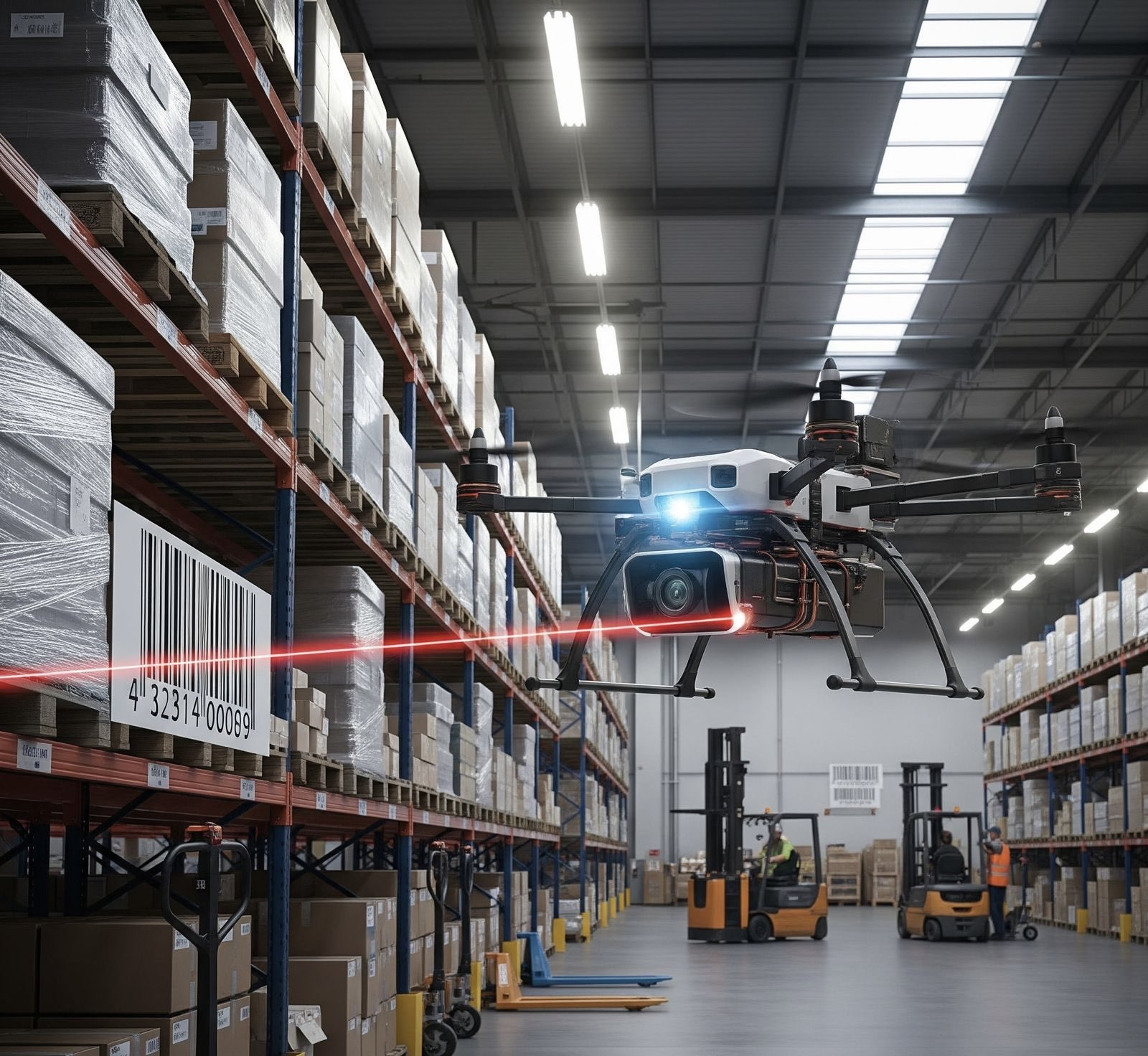
In traditional environments, cycle counts and audits often require staff to climb lifts, navigate narrow aisles, and manually scan barcodes or RFID tags. These methods are time-consuming, error-prone, and can pose safety risks. Drones equipped with scanning sensors offer a more innovative alternative: they zip along warehouse aisles, fly into high-reach areas, and capture readings in minutes; no human ladders required.
Faster, Safer, More Accurate
Companies integrating drones into their inventory systems are seeing quantifiable gains. In one setup, drone-assisted scanning reduced inventory time from several days to mere hours, cutting costs significantly and improving accuracy to near-perfect levels. Large brands, such as IKEA, have adopted AI-powered drones that track items and alert to misplaced goods, while also avoiding collisions through specialized navigation systems. Another manufacturer reduced its once 90-day complete inventory cycle to just 2.5 days by using drone-powered monitoring, improving accuracy by roughly 70% even in already efficient facilities.
The Intelligent Edge
State-of-the-art systems go beyond mere scanning. Autonomous drones now feed real-time insights directly into Warehouse Management Systems (WMS), ERP platforms, or Manufacturing Execution Systems (MES), enabling instant reconciliation of discrepancies before they disrupt production. Some advanced prototypes utilize RFID readers, cameras, and LiDAR sensors to autonomously navigate warehouse aisles, identify items, and avoid unexpected obstacles, all without relying on GPS.
A newer innovation combines drone data with blockchain to ensure tamper-proof traceability, making it particularly useful in regulated or audit-sensitive environments. Drones scan RFID-tagged items, timestamp the data, and store it securely in a distributed ledger for reliable audit trails.
Voices from the Field
Operators who have implemented drone-assisted inventory share similar stories: pallets stacked high that once required hours of manual scanning can now be checked in minutes, and inconsistencies are flagged automatically. Others note the benefit in sprawling yards or outdoor storage areas, where drones with RFID readers can quickly map equipment and product locations based on signal and timestamp data.
Conclusion
As manufacturing and warehousing evolve toward Industry 4.0, drone-assisted inventory systems are redefining what’s possible. They combine speed, accuracy, safety, and intelligence, and relieve human operators from routine tasks so they can focus on higher-value work. From global retail rollouts to niche blockchain-backed solutions, drone-powered inventory management is no longer a futuristic idea; it’s here and taking flight.
Sources
- The Benefits of Using Drones for Efficient Inventory Management - EOXS
Website: https://eoxs.com/new_blog/the-benefits-of-using-drones-for-efficient-inventory-management/ - Warehouse Drones and Logistics - Mecalux
Website: https://www.mecalux.com/blog/drone-inventory-management - IKEA Stock-Counting Drones Deploying in U.S. with AI-Powered Upgrades - The Verge
Website: https://www.theverge.com/2024/8/16/24221688/ikea-drones-us-warehouse - Autonomous Drone Inventory Monitoring - Gather AI
Website: https://www.gather.ai/news/manufacturing-technology-inventory-drones - Fast Autonomous Flight in Warehouses for Inventory Applications - arXiv
Website: https://arxiv.org/abs/1809.06628 - UAV and Blockchain-Based System for Inventory - arXiv
Website: https://arxiv.org/abs/2402.00709 - Drone Inventory Discussion - Reddit Supply Chain
Website: https://www.reddit.com/r/supplychain/comments/12rhq6n