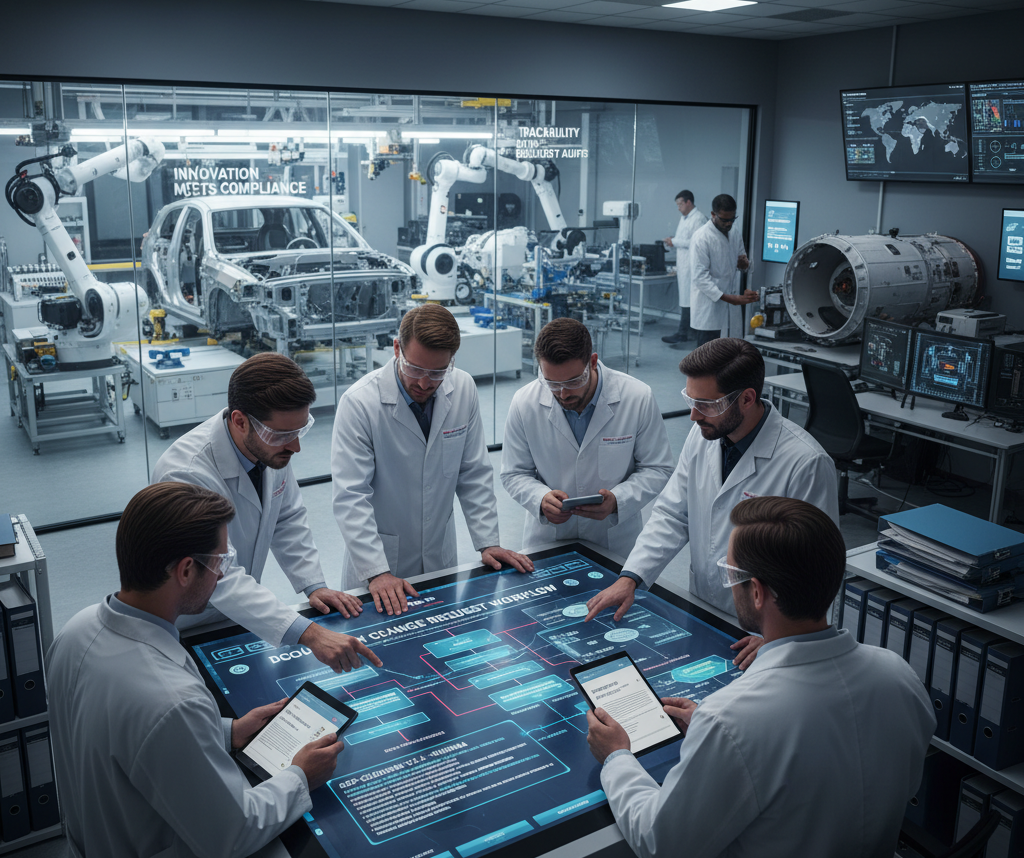
Document Change Request (DCR)
Understanding Document Change Requests (DCR) in Manufacturing
By: Destiny Dickerson
In the world of manufacturing, documents are more than just paperwork; they are the backbone of consistent production, safety, and compliance. From standard operating procedures (SOPs) to instruction manuals and quality guidelines, documentation provides the framework workers rely on daily. But because industries constantly evolve, documents cannot remain static. This is where a Document Change Request (DCR) becomes essential.
A DCR is a formal proposal to revise an existing document within the manufacturing process. Instead of making informal edits, the DCR process ensures every change is reviewed, approved, and implemented in a controlled manner. This structure is critical in regulated industries where compliance with organizations such as the FDA, ISO, or FAA is mandatory. A single outdated instruction manual could result in failed audits, costly recalls, or even safety hazards.
For example, in the pharmaceutical industry, when cleaning procedures are updated to meet new FDA sterilization guidelines, companies cannot simply notify staff by word of mouth; instead, they must implement a formal communication plan. A DCR must be submitted, reviewed, and approved before the official SOP is updated. Similarly, in the automotive industry, when new robotics are introduced on an assembly line, operator manuals must be revised through a DCR to ensure proper use and worker safety. In the aerospace industry, manufacturers rely on DCRs to align their maintenance manuals with evolving FAA safety standards.
The DCR process typically follows a structured workflow. First, a request is submitted outlining the proposed change and its justification. Then, a review team evaluates the request for accuracy, compliance, and potential impact. If approved, the revised document is distributed, and old versions are archived to maintain a clear record of revisions. This traceability not only prevents confusion but also demonstrates accountability during regulatory audits.
What makes DCRs so important is their ability to strike a balance between innovation and compliance. Startups introducing new technologies, such as robotics or digital tools, depend on DCRs to update documentation quickly without compromising safety. Meanwhile, legacy manufacturers rely on them to maintain global consistency across their vast operations. In both cases, the DCR process provides a bridge between evolving practices and the written instructions that guide day-to-day work.
In short, Document Change Requests may not make headlines, but they are one of the most powerful tools in modern manufacturing. By keeping documents aligned with innovation and regulation, DCRs ensure efficiency, compliance, and safety, three pillars that no manufacturer can afford to overlook.
Sources:
- Arena Solutions - Document Change Request (DCR) Definition
https://www.arenasolutions.com/resources/glossary/document-change-request/ - GES Repair - What Are Manufacturing Change Requests, and Why Are They Important?
https://gesrepair.com/what-are-manufacturing-change-requests-and-why-are-they-important/ - GMP SOP - Document Change Control Process in GMP Environment
https://www.gmpsop.com/document-control-process-in-gmp-environment/