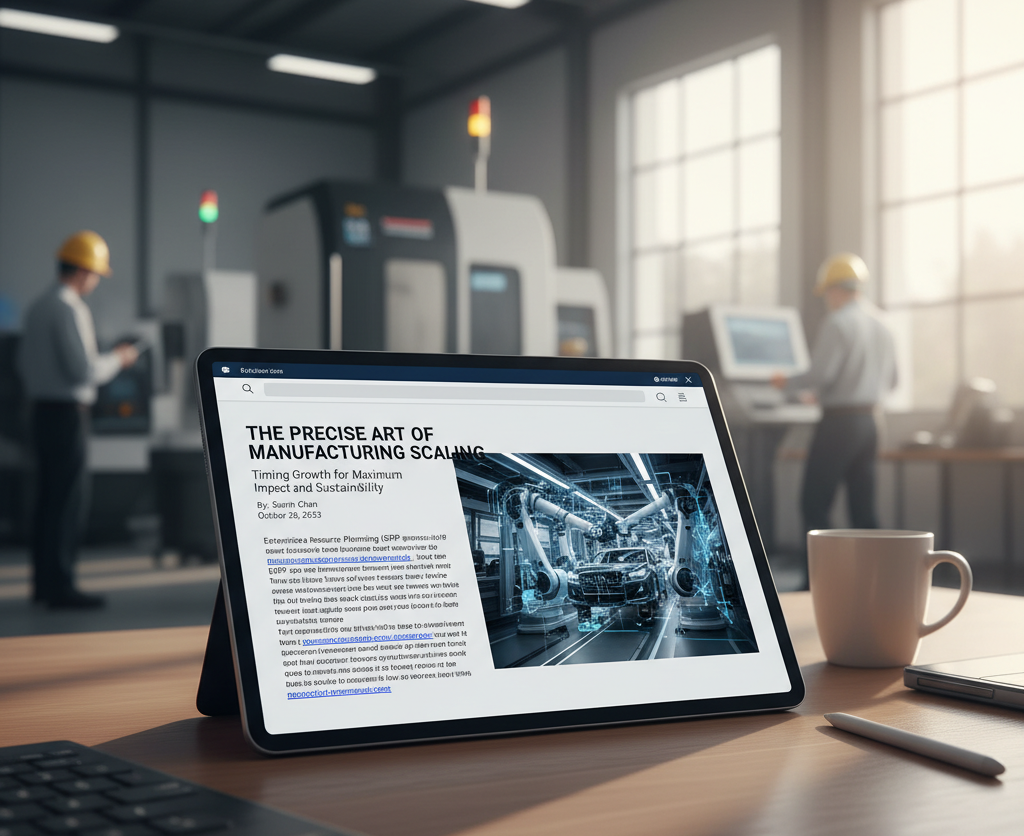
Scaling the Business
Finding the Right Moment in Manufacturing Growth
By: Destiny Dickerson
For manufacturing businesses, growth is never just about producing more; it’s about knowing when and how fast to grow. Scaling too early can stretch finances thin, overfill warehouses with unsold inventory, and create production inefficiencies. On the other hand, waiting too long to expand can cause missed opportunities and open the door for competitors to take the lead. Striking the right balance between speed and stability is one of the most difficult challenges manufacturers face.
The key lies in timing. When a company scales too soon, production outpaces demand, leading to dead stock and wasted resources. For example, a furniture manufacturer that doubles production without confirming sufficient sales demand may end up holding unsold products for months, tying up capital that could have been reinvested elsewhere. Conversely, a company that delays scaling might lose customers to faster, more responsive competitors who can meet growing demand immediately.
Technology now plays a crucial role in helping manufacturers navigate these decisions. Enterprise Resource Planning (ERP) systems, for instance, allow managers to integrate every aspect of their operations, from procurement and inventory to production and sales, into one centralized platform. With real-time visibility into performance data, manufacturers can make smarter scaling decisions based on actual demand trends instead of relying on gut instincts. If a surge in orders is detected early, production lines can be adjusted efficiently without overwhelming resources.
Take automotive suppliers as an example. When electric vehicle demand spiked, suppliers with digital monitoring systems could see increases in parts orders and adapt quickly by adding shifts or reallocating resources. Those without such insights often faced long lead times or missed out on lucrative contracts altogether.
Strategic scaling also requires aligning growth with long-term goals. It’s not just about adding machines or hiring more workers; it’s about understanding how each operational change affects the overall business. ERP systems, supported by predictive analytics, can model different scaling scenarios, such as introducing new product lines or expanding into new markets, and forecast potential outcomes. This helps manufacturers identify bottlenecks before they occur, minimizing risks of production delays or overcapacity.
Ultimately, scaling in manufacturing is about precision and foresight. By leveraging data-driven tools and integrating technology across departments, companies can grow sustainably, meet rising customer demand, and stay competitive in a rapidly evolving market. Growth, when done right, becomes a carefully timed move, not a gamble.
Sources
- https://www.tcgen.com/time-to-market
- https://www.mbtmag.com/home/article/13250529/how-to-scale-your-manufacturing-business
- https://www.erpsoftwareblog.com/2023/03/why-erp-is-essential-for-scalable-manufacturing/
- https://www.industryweek.com/operations/continuous-improvement/article/21275432/data-driven-scaling-in-manufacturing